 3:21
 3:40
 3:30
 3:39
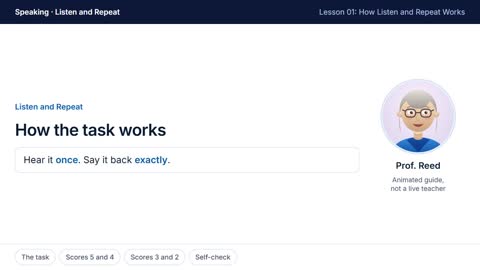 2:44
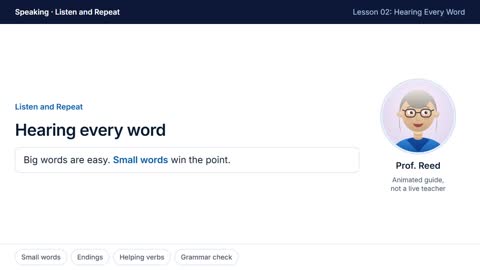 2:48
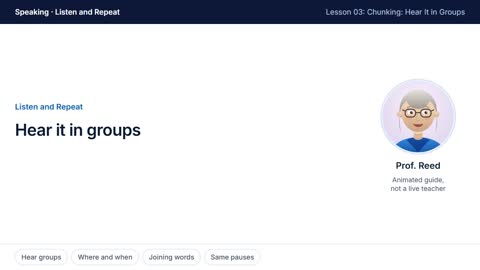 3:32
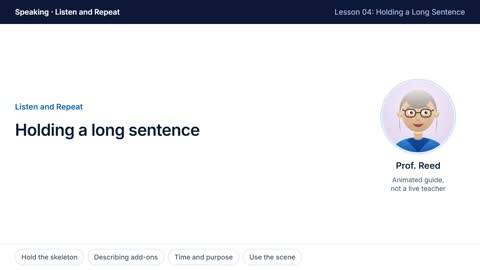 3:23
 3:05
 3:38
Test 1Next
Starter
Free TOEFL Speaking practice tests and lessons
You need a microphone. Recordings stay on this device unless you ask for a score.
Learn
2 task types19 video lessonsStart here and Clear Speech
Listen and Repeat
Take an Interview
 3:011How the Interview Works
 3:042Understanding the Question
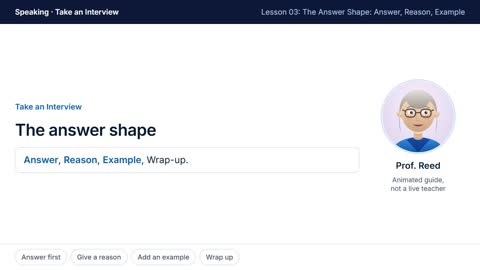 2:493The Answer Shape: Answer, Reason, Example
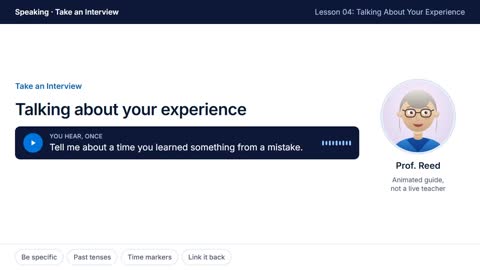 2:564Talking About Your Experience
 2:455Giving and Supporting Opinions
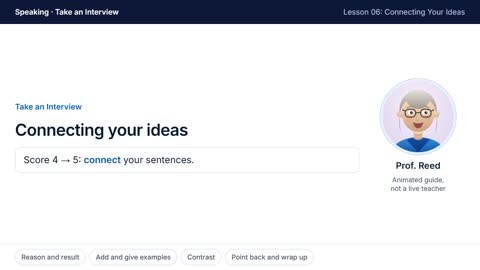 3:036Connecting Your Ideas
 3:097Fluency: Pace, Pauses and Fillers
 3:108Your Own Words, and Recovering
 3:119Forty-Five Seconds, Four Times
Practise
40 practice sets1Listen and Repeat
0/6 lessons · 0/20 sets · 7 sentences, about 2 min a set
See all 20 sets by level
2Take an Interview
0/9 lessons · 0/20 interviews · 4 questions, about 4 min each
See all 20 interviews by level
Practice tests
About 8 minutes · scored 1–6
Test 2
Starter
Test 3
Starter
Test 4
Core
Test 5
Core
Test 6
Core
Test 7
Core
Test 8
Advanced
Test 9
Advanced
Test 10
Advanced
Guides
How close is this to the real TOEFL iBT? What matches the updated TOEFL iBT, and what to keep in mind.
Screens like the real testEach sentence or question plays once, with no text. You hear a beep, then answer while the response time counts down.
Scored with the ETS guideEach answer is marked 0 to 5 on the ETS rubric, and the test gives a band from 1 to 6: from the sound for pronunciation, pace and pauses, and from your words for content.
Not official ETS questionsEvery sentence and question is written for practice, to match the task types.
Free, and your voice is not keptNo account. Recordings stay on your device unless you ask for a score; then they are scored and not stored.
About the TOEFL Speaking section (2026). What is on the updated TOEFL iBT, as listed by ETS. See the full test format.
11 items7 Listen and Repeat sentences, then 4 interview questions.
About 8 minutesAbout 45 seconds for each interview answer.
2 task typesListen and Repeat, Take an Interview.
Band 1 to 6A full Speaking test here gives a practice band.
How to improve your TOEFL Speaking score. Six habits that help, each with the practice for it.
1. Listen and Repeat: hear it in groups
Hear the sentence as a few word groups, not single words. It is easier to hold and say back exactly.
Practise Listen and Repeat2. Keep going after a mistake
There are seven sentences in a row. If one goes wrong, let it go and give the next one your full attention.
Practise seven in a row3. Interview: answer in the first sentence
Give your answer first, then a reason and a short example. That fits well in about 45 seconds.
Practise interview questions4. Work on stress and linking
Word stress, intonation and linking make you easier to understand, even with an accent.
See the Speaking lessons5. Check your microphone first
A quick mic check makes sure your answers are recorded clearly.
Check your microphone6. Take a full test in one go
A full Speaking test runs both tasks in a row, in about 8 minutes, like test day.
See the full Speaking testsTOEFL Speaking questions: interview examples. Real sets from our Take an Interview practice.
Reading habits
You have agreed to take part in a research study about the reading habits of adult learners. A researcher will ask you some questions.
- What kind of things do you usually read in a normal week?
- Tell me about something you read recently that you really enjoyed.
- Do you prefer reading printed books or reading on a screen? Why?
- Some people say adults today read less than adults did in the past. Do you agree?
Model answer to question 1
In a normal week, I mostly read news articles and messages on my phone, but I also try to read one proper book. The main reason is that my job keeps me quite busy, so short articles are easy to fit into my lunch break. For example, last month I started a novel about a family living in an old part of Lahore, and I read about ten pages every night before bed. It took me nearly four weeks to finish, but I really enjoyed it because it felt like a break from the screen. So overall, I read a lot of short things and a little bit of slower, longer reading too.
Phones in class
Your university is carrying out a study about how students use mobile phones in class. A researcher will ask you some questions about your experiences.
- Tell me about how you've used your phone during lessons or lectures.
- Would you prefer to take notes in class on paper or on a phone or laptop? Why?
- Some teachers ban phones completely in class, while others allow them for learning. What are the advantages and disadvantages of each approach?
- In your opinion, should universities create a single rule about phones for all classes?
Model answer to question 1
To be honest, I've used my phone in class in both good and bad ways. On the useful side, I often take photos of the whiteboard so I can review the diagrams later, and sometimes I look up a word I don't understand. But I'll admit that I've also checked messages when a lecture got boring. For example, in an accounting class last term, I realised I'd spent almost ten minutes reading the news while the teacher explained a new topic. Afterwards, I had to ask a classmate to explain it again. Since then, I've tried to keep my phone in my bag unless I really need it.
Getting around the city
A research team working with the city council is studying how residents travel around the city. You have agreed to answer some questions about transport.
- How do you usually get to your classes or workplace each day?
- Describe a time when public transport in your city did not meet your needs.
- If the city had money for only one project, should it build more cycle lanes or increase the number of buses? Explain your choice.
- Some cities charge drivers a fee to enter the city centre. Is this a fair way to reduce traffic and pollution?
Model answer to question 1
Most days I cycle, which takes about twenty minutes. I used to take the bus, but it was frequently delayed during the morning rush hour, and I was late for my first lecture more often than I'd like to admit. Switching to a bike solved that problem almost immediately. It's also cheaper, since I no longer pay for a monthly pass, and it's a convenient way to fit some exercise into a busy schedule. The only real drawback is the weather. When it's pouring with rain, I'll still take the bus, even though I know it might be slow. Overall, though, cycling has made my commute far more predictable.
Common questions about TOEFL Speaking practice.
How long is the TOEFL Speaking section?
ETS lists 11 items in about 8 minutes: 7 Listen and Repeat sentences, then a 4-question interview.
Do I need a microphone?
Yes. You answer out loud and your browser records you. Use the mic check before you start.
Are these TOEFL Speaking practice tests free?
Yes. The 10 full Speaking tests, the Listen and Repeat sets, the interview sets and the lessons are free, with no account.
Are these official TOEFL questions?
No. Every prompt is written for this site and follows the task types of the updated TOEFL iBT. toeflprep.online is not affiliated with ETS.
Read more: The new TOEFL iBT format, section by section